
Introduction: The Struggle with Modern Project Management
In today’s fast-paced business environment, managers face a constant challenge: How do you accurately track work distribution across teams? How do you measure individual contributions to shared projects? Traditional project management tools have hit a wall when it comes to granular work allocation and productivity measurement. Most platforms still operate on an outdated “one task, one assignee” model that fails to reflect how collaborative work actually happens in modern organizations.
Enter Qanban – a forward-thinking project management platform that’s breaking the mold with its groundbreaking new feature: Multi-Assignee Task Allocation with Percentage-Based Work Distribution. This innovation isn’t just another incremental update; it’s a paradigm shift in how teams collaborate, managers allocate resources, and organizations measure productivity.
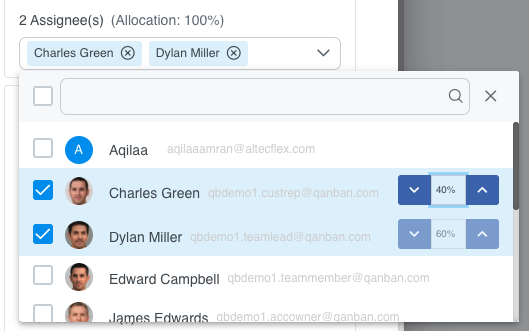
The Game-Changing Feature: Percentage-Based Multi-Assignee Allocation
What Makes This Different?
Qanban’s latest release introduces a simple yet powerful concept: any task, story, program, or epic can now be assigned to up to 10 team members simultaneously, with each assignee receiving a specific percentage allocation of the total work. Let’s break down what this looks like in practice:
Real-World Example:
A marketing campaign requires collaboration between multiple specialists:
- John (Content Strategist): 30% allocation for content planning
- Mary (Graphic Designer): 40% allocation for visual assets
- David (Social Media Manager): 20% allocation for distribution
- Sarah (Analytics Specialist): 10% allocation for performance tracking
Unlike traditional tools that would require creating four separate tasks or using vague tags, Qanban allows managers to create a single task with precise allocation percentages. This mirrors how work actually happens in reality – multiple contributors with varying levels of involvement on shared objectives.
The Market Gap: What Other Tools Are Missing
A thorough analysis of the current project management landscape reveals a significant gap. Major platforms like Jira, Asana, Trello, Monday.com, and ClickUp – while excellent in many respects – lack this precise percentage-based allocation capability. Here’s what we found:
- Jira: Supports multiple assignees through plugins only, with no native percentage allocation
- Asana: Allows task assignment to multiple people but treats all as “100% responsible”
- Monday.com: Has “contributors” but no way to quantify contribution levels
- ClickUp: Offers “assignees” without granular work distribution metrics
- Basecamp: Fundamentally designed for single assignee per task
This market gap represents a significant pain point for managers who need to accurately forecast timelines, allocate budgets, and measure individual productivity in collaborative environments.
Why This Matters: Solving Real Business Problems
The Time Sheet Revolution
The most immediate application of this feature is in automated time sheet generation. With work percentages clearly defined, Qanban will soon launch an intelligent time tracking system that automatically suggests time allocations based on task percentages. This addresses several critical business challenges:
- Eliminating Guesswork: Employees no longer need to estimate how much time to log against shared tasks
- Accurate Project Costing: Managers get precise data on actual time investment by percentage allocation
- Reduced Administrative Overhead: Automatic time sheet generation saves hours of manual entry weekly
Imagine a scenario where John simply opens his time sheet and sees suggested entries based on his 30% allocation to the marketing campaign task. With one click, he can confirm or adjust – saving time while maintaining accuracy.
Unprecedented Productivity Insights
Beyond time tracking, this feature delivers what many organizations have been desperately seeking: meaningful productivity metrics. Companies often invest in expensive employee monitoring software or complex productivity tracking systems, only to get questionable data that doesn’t reflect actual contribution to business outcomes.
Qanban’s approach solves this by providing insights based on actual work allocation and completion:
- Individual Contribution Analysis: See exactly how much each team member contributed to shared deliverables
- Work Distribution Health: Identify imbalance in team workload before burnout occurs
- Skill-Based Allocation Optimization: Discover which team members perform best at specific types of work based on their percentage completion rates
For managers searching for “tools to capture employee productivity” or “ways to measure team contribution,” this feature represents a breakthrough. Instead of tracking keyboard strokes or screen time, Qanban measures what matters: contribution to actual business objectives.
Technical Innovation: How It Works Under the Hood
Intelligent Allocation Engine
Qanban’s multi-assignee system isn’t just a simple database field – it’s powered by an intelligent allocation engine that:
- Validates Percentages: Ensures total allocation never exceeds 100% across all assignees
- Integrates with Existing Workflow: Works seamlessly with Qanban’s existing task dependencies, due dates, and priority systems
- Provides Real-Time Updates: Automatically recalculates remaining work as team members complete their portions
Flexible Implementation Options
Teams can implement this feature in multiple ways:
Option 1: Manager-Driven Allocation
Managers set percentages based on estimated effort required, skill levels, and current workload
Option 2: Team-Negotiated Distribution
Team members collaboratively decide percentages during planning sessions, promoting ownership and transparency
Option 3: Historical Data-Based Suggestions
Qanban can suggest percentages based on historical performance on similar tasks
Use Cases Across Industries
Software Development Teams
In agile environments, complex user stories often require multiple developers with specialized skills. A backend-heavy story might allocate 60% to database engineers and 40% to API developers, with precise tracking of who contributed what.
Marketing Agencies
Campaign development involves copywriters, designers, strategists, and analysts. Agencies can now accurately bill clients based on actual specialist time rather than rough estimates.
Consulting Firms
Project-based work with multiple consultants contributing different expertise can now be tracked with precision, improving both client billing and internal resource planning.
Research and Development
Cross-functional R&D projects with scientists, engineers, and analysts can maintain clear contribution records for patent applications and innovation tracking.
Implementation Best Practices
Getting Started with Multi-Assignee Tasks
- Start Small: Begin with a pilot project using 2-3 assignees to familiarize your team with the concept
- Train Your Team: Ensure everyone understands how percentages reflect expected effort, not importance or value
- Review Regularly: Check in weekly to adjust percentages if work scope changes
- Combine with Clear Documentation: Use task descriptions to specify what each percentage allocation covers
Common Pitfalls to Avoid
- Micromanagement Temptation: Percentages should guide, not dictate, daily work
- Over-Complication: Not every task needs multiple assignees – use judgment
- Neglecting Communication: Percentage allocation complements but doesn’t replace team communication
The Future Roadmap: What’s Coming Next
Time Sheet Automation (Beta Coming Q2 2026)
Our development team is currently building an intelligent time sheet system that:
- Automatically generate time entries based on task allocations
- Enable time adjustments to improve accuracy
Advanced Analytics Dashboard (Planned for Q3 2026)
Future updates will include:
- Productivity Trend Analysis: Track individual and team productivity over time
- Capacity Planning Tools: Forecast team bandwidth based on historical allocation patterns
Conclusion: A New Era of Transparent Collaboration
Qanban’s multi-assignee feature with percentage-based allocation represents more than just a technical innovation – it’s a philosophical shift toward transparent, measurable collaboration. In a business landscape increasingly focused on remote work, distributed teams, and outcome-based evaluation, this feature provides the missing link between collaborative work and individual accountability.
For companies searching for “employee productivity tracking software,” “team workload management tools,” or “accurate project time tracking solutions,” Qanban now offers what no other platform provides: a system that reflects how work actually happens in the modern workplace.
The era of guessing about team contributions and struggling with inaccurate time sheets is ending. With Qanban’s latest innovation, managers finally have the tools they need to allocate work precisely, track contributions accurately, and understand productivity meaningfully – all while respecting the collaborative nature of modern work.
Ready to transform how your team manages collaborative work? Sign up for a Qanban account today to experience firsthand how percentage-based multi-assignee allocation can bring unprecedented clarity to your project management and productivity tracking.